DISC Personality Profiling
DISC profiles help you and your team to facilitate better teamwork and minimise team conflict
DISC Personality Test
DiSC Personality tool has been used successfully to help people learn to work more effectively with others. Through personal insights into their own behavioural strengths and challenges, participants in DiSC trainings learn to relate to others.
DiSC Profiling does more than providing insights into a person’s behaviour and character. The profiles were created with the workplace relationships in mind and offer strategies for working with, leading, managing, or selling to others.
The test instrument and the profile results are designed so that it’s easy to understand and recall your behavioural style and insights. The writing is engaging and the visuals are memorable. It is easy to understand your profile from a trained professional.
With the help of our professional facilitator, the participants will be able to discover their own and other people behavior characteristics and use their skills to improve relationship and communication among each other and other people they interact with.
With DISC you not only improve the team skills and work environment but you bring the business to new better level.
Get A Free Quote
Everything DISC Assessments
for building a more collaborative workplace
The true potential of any organization lies with its people. Everything DiSC, the original assessment-based learning experience, helps your people re-connect to themselves and each other, embracing their diverse strengths and behavior styles.

Everything DISC Agile EQ Profiling
Boost emotional IQ and learn more effective ways to respond to rapidly changing workplace situations.
Explore Agile EQ Profiling
Everything DISC Productive Conflict
Transform destructive behaviors into productive, collaborative working relationships.
Explore DISC Productive Conflict
Everything DISC Management Profiling
Engage, motivate, and develop your organizational leaders.
Explore DISC Management Profiling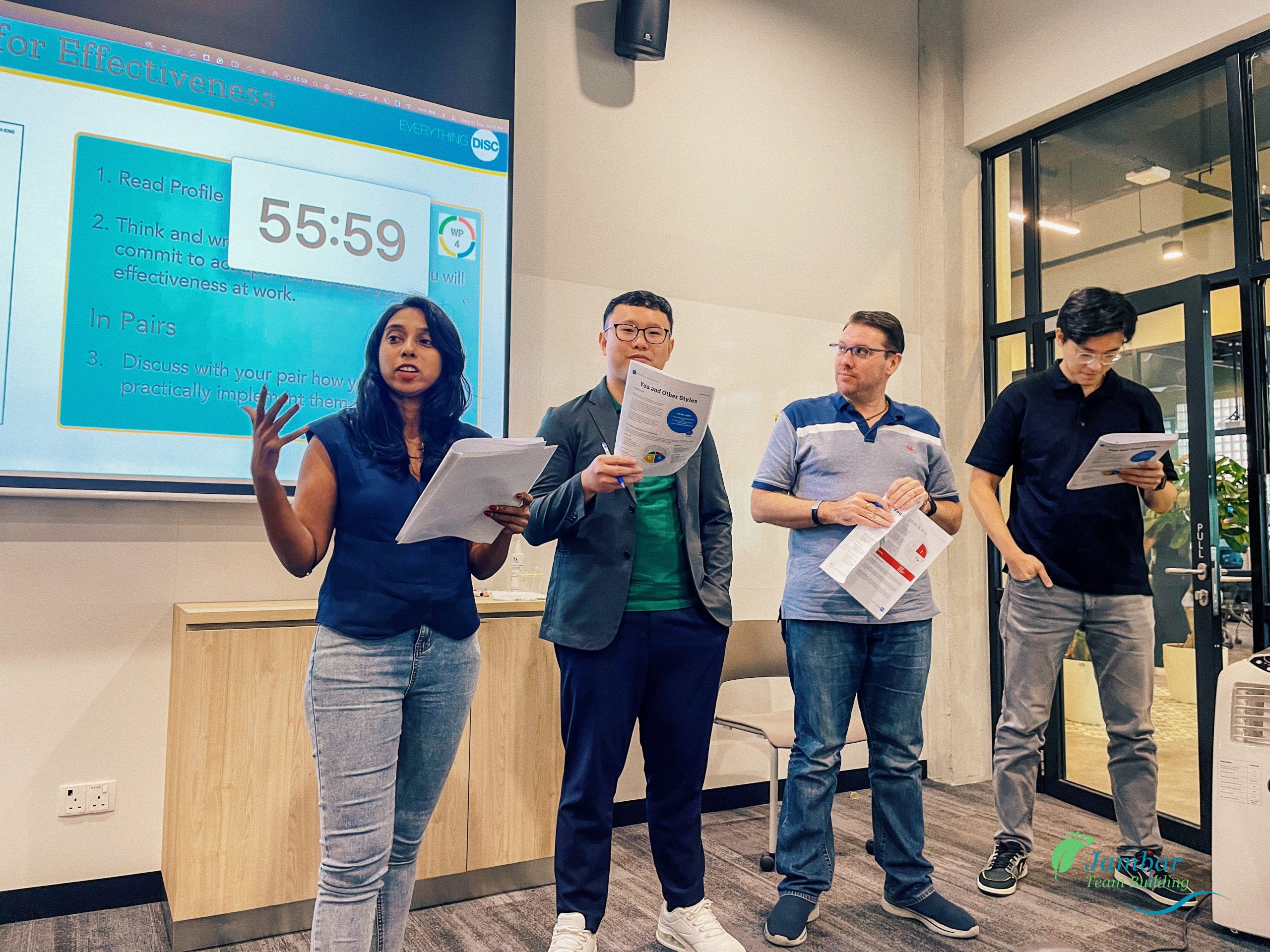
Everything DISC Work of Leaders
Learn the real work of leaders – Vision, Alignment, Execution and where you stand against the best practices for each.
Explore DISC Work of Leaders
Everything DISC Sales Profiling
Sales effectiveness improves when you know the preferences and expectations of your customers.
Explore DISC Sales Profiling
Facilitated workshop sessions for All Levels
A workshop will increase peoples’ understanding of themselves and their colleagues, helping to resolve conflict in the work environment and focusing the team on achieving its objectives more effectively.
The purpose of a profiling workshop is to increase communication and effectiveness within the team or group so that it achieves it objectives. The team will have a common language and a framework to discuss their collective strengths and how best to use them.
DISC Workshop Testimonial
DISC Profiling by Jambar

A short history
“Emotions of Normal People” is a book written by Dr. William Martson in 1928, explaining how human emotions in groups and situations evolve over time.
The initial theoretical work was first published in the 1920s. Throughout the years, the product has been continually evolving to become more reliable, simple to administer and memorable for the user.
DISC Profiling
DiSC Profiling is a personal and group assessment tool used to improve work productivity, teamwork and communication. It is non-judgmental, and assists people in understanding their behavioural differences.
The DiSC model provides a common language that people can use to better understand themselves and adapt their behaviours to others. This can be within a work team, a sales relationship, a leadership position, or other relationships. DiSC Profiling not only facilitates better teamwork or minimise team conflict, it also provides skills that are transferrable to other areas such as sales and management. Sales personnel can use this to hone their sales skills to identify and respond to the various customer styles effectively. On the other hand, those in management positions can use this to better understand their employees and team members, thereby helping them become more perceptive, holistic and effective leaders.
For this program, participants will be required to finish a survey the day preceding. The responses to these questions will then be used to generate a report regarding their personalities and behaviours, which will be used to drive the discussion on the day of the program.
Frequently Asked Questions, answered
What is DISC and what does it actually tell us?
DISC is a behavioural assessment that gives your team a common language for how people work! It maps behaviour across four styles, and the real value isn’t the label someone gets. It’s that colleagues end up with a shared way to talk about why people approach the same work differently.
How does a DISC session run?
Before the session, each participant completes a quick online DISC assessment (about 10 to 15 minutes) that pinpoints their behavioural style across Dominance, Influence, Steadiness and Conscientiousness. On the day, a facilitator brings the four styles to life through games, role plays and lively group challenges: people physically map themselves and their colleagues onto the model, spot the moments where styles spark or clash, and laugh at how accurately it explains the team’s quirks, leaving with practical, memorable ways to get the best out of each other.
Do people need to do anything beforehand?
Yes, just one thing: each participant completes the online DISC assessment before the session. It takes about 10 to 15 minutes, is done individually at their own convenience via a link sent in advance, and there is no preparation or right answers involved. Ideally the links go out around two weeks before the program, which gives everyone time to complete the assessment and gives us time to print the reports. Everything else happens on the day.
What do participants take away?
Each participant takes away their own printed DISC profile report, a personalised breakdown of their behavioural style, how they prefer to communicate and make decisions, what energises and stresses them, and how to adapt when working with the other styles. Beyond the report, they leave with a shared language the whole team can use, a clearer read on their colleagues’ styles, and practical, memorable ways to flex their own approach so collaboration, feedback and everyday interactions run more smoothly.
Is there an online platform for after the event?
Yes. Everything DiSC is delivered on Catalyst, Wiley’s online learning platform, and every participant keeps access to it after the event. On Catalyst they can revisit their own profile any time, use the “Your Colleagues” feature to compare styles with teammates and get tailored tips on working with each specific person, and explore additional content on communication, conflict and motivation at their own pace. New joiners can be added later so the team map stays current, which makes it a practical way to keep the DISC language alive long after the session rather than a one-day experience.
Which of the five DISC programmes should we choose?
It depends on who’s attending! Management is great for people running teams, Work of Leaders for senior leaders setting direction, Sales for customer facing teams, Productive Conflict where there’s friction, and Agile EQ for building emotional intelligence. Tell us about the group and we’ll happily point you to the right one.
How is DISC different from MBTI?
DISC is about observable behaviour, how someone tends to act at work, which makes it quick to apply the very next morning. MBTI is about cognitive preference, how someone takes in information and makes decisions, which goes deeper into the why. If you’d like something your team can use straight away, DISC is usually the one.
How is DISC different from Belbin?
DISC is about the individual: how each person tends to behave at work and how to work with them. Belbin is about the team: which of the nine roles you already cover and which nobody is filling. If you want colleagues to understand each other better, go for DISC. If you want to know what your team as a whole is missing, Belbin is your pick.

Download a full sample of a DISC Profile Report
The DISC model is a simple tool that’s been helping people to connect better for over thirty years. This report uses your individual assessment data to provide a wealth of information about your workplace priorities and preferences. In addition, you’ll learn how to connect better with colleagues whose priorities and preferences differ from yours.
What People Say About Our Workshops
Training Modules
| Time | Session |
|---|---|
| 09.00 – 09.15 | Commencement of program General program briefing. |
| 09.15 – 10.00 |
Pre-framing activities
QuikDiSC exercise The objectives of this exercise are to get participants acquainted and comfortable with one another, and to open the doors for effective communication. This creates a vulnerability that helps open up lines of communication between people. |
| 10.00 – 10.15 | Introduction of DiSC Profiling Short history of the DiSC Profiling tool. |
| 10.15 – 11.45 |
DiSC Workplace Profile – 3 modules
|
| 11.45 – 12.30 |
Discussing and sharing
|
| 12.30 | End of program |
| Time | Session |
|---|---|
| 09.30 – 10.00 | Morning coffee / tea break |
| 10.00 – 10.15 | Commencement of program General program briefing. |
| 10.15 – 10.45 | Pre-framing activities — QuikDiSC exercise The objectives of this exercise are to get participants acquainted and comfortable with one another, and to open the doors for effective communication. This creates a vulnerability that helps open up lines of communication between people. |
| 10.45 – 11.00 | Introduction of DiSC Profiling Short history of the DiSC Profiling tool. |
| 11.00 – 12.00 | Module 1 — Discovering your style Learn about your DiSC style, how your priorities influence others through your actions, and what motivates and stresses you. |
| 12.00 – 13.00 | Lunch |
| 13.00 – 14.00 | Module 2 — Understanding other styles Get into groups according to the character you least want to work with. Read about how you might react to that character, then record on a handout what is difficult and what works for you when working with that style. Share with your small group and create a flip chart showing what is difficult and what works. Repeat the exercise with the character you most want to work with. Each group presents their flip chart to the large group, and participants use the information to complete the charts on their handouts. Finally, use stickers to identify one characteristic you find most difficult and one that works most for you on each flip chart, and discuss with the large group. |
| 14.00 – 15.00 | Module 3 — Building more effective relationships Learn personalised strategies for building a more effective relationship with one style of your choice. Select one overall strategy and write an action plan for using it in your workplace. Finally, complete the front side of the Everything DiSC Workplace Style Guide to display in your workspace. |
| 15.00 – 15.15 | Afternoon coffee / tea break |
| 15.15 – 16.15 | Activity — DiSC and disagreement How would you respond to a serious customer complaint if you knew the injured person was a D, i, S, or C? Assume that you failed to deliver on a promise or meet a deadline. You can also write a complaint about poor service (a failed car repair, for example) as if you were each type. |
| 16.15 – 17.00 |
Discussing and sharing
|
| 17.00 | End of program |